





50 years of experience and technology development give us a unique competitive advantage in wet scrubber design and acid gas controls. Our innovations and achievements over the years include:
- More than 1,400 wet scrubber installations, including 300 flue gas desulfurization (SO2) units
- Supplier of acid gas scrubbing systems utilizing a variety of reagents
- Advanced venturi designs
- Increased control and absorption efficiencies
- Customer Satisfaction
Wet Scrubber Systems Types:
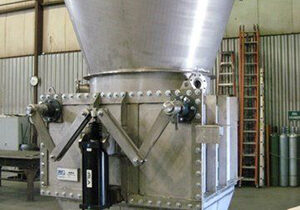
Venturi & Cyclonic Scrubbers
Venturi and cyclonic scrubbers are wet scrubbers that control pollution with turbulent water at an engineered pressure range.
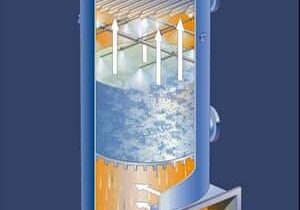
Acid Gas Absorbers
Wet control processes can use multiple stages of design styles in wet scrubbers to target varied sizes of particulates and mists.
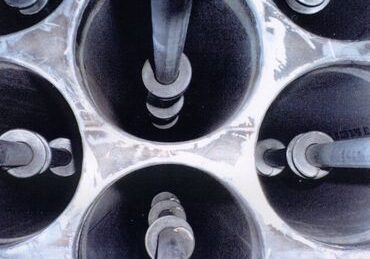
Wet Electrostatic Precipitators
The “small particle” polishing benefits of wet electrostatic precipitators are helping facilities meet the new EPA standards.
How a Wet Scrubber or Venturi Scrubber Works
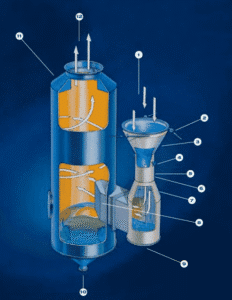
- Dusty exhaust gas enters the flanged Venturi Scrubber Inlet connection via ductwork from the process/emission source.
- Tangential Feed Pipes introduce scrubbing liquid supplied by the Recycle Pump. These are straight open pipes with no use of any spray nozzles that could plug and erode.
- The scrubbing liquid that is introduced swirls down through the Venturi Converging Section with a “dentist bowl” effect, providing the liquid for atomization and protecting the surfaces from both abrasion and build-up. The gas stream is accelerated due to the reduced cross-sectional area.
- Additional Radial Liquid Feed Pipes introduce more scrubbing liquid to ensure complete coverage of the round cross-section Venturi Throat.
- In the Mixing/Collision zone particulate is captured in the scrubbing liquid droplets created by the exhaust gas stream accelerated in the Venturi Scrubber.
- Pressure drop (related to exhaust gas velocity) across the Venturi Throat determines the collection efficiency achievable. Higher pressure drops allow greater collection efficiency. To accommodate fluctuating exhaust gas volumes, a damper is used to adjust the throat cross-sectional area to maintain operating pressure drop (for a constant efficiency)
- A long generous Diverging Section below the Venturi Throat promotes extended contact time for the particulate and scrubbing liquid and assists with pressure drop regain.
- The gas/liquid mixture turns and enters the Cyclonic Separator Inlet where it is accelerated into the spin zone. The entrained scrubbing liquid with captured particulate is removed via centrifugal force and drains to the bottom recycle sump section of the Separator vessel.
- A liquid reservoir in the bottom of the “Flooded Elbow” serves to cushion impact and prevent abrasion of metal surfaces.
- The scrubbing liquid with captured particulate drains to the Recycle Pump for recirculation back to the Venturi feed pipes while a small portion (“bleed”) is removed for disposal or treatment.
- Anti-Spin Baffles stop the gas spin and straighten the flow before the cleaned exhaust gas exits the Separator to an Exhaust Stack or ductwork.
- Cleaned exhaust gas exits the flanged Separator Outlet connection.
Need Information? Tell us your request.
"*" indicates required fields
MACT Standards and New EPA Rules
Boiler MACT Compliance
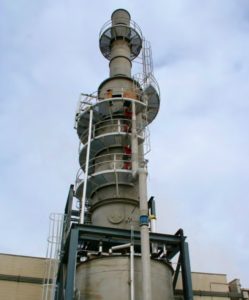 When the U.S. Environmental Protection Agency (EPA) finalized its adjustments to the Clean Air Act standards it issued a rule imposing stricter emissions limits on industrial and commercial boilers, process heaters for boilers, and certain solid waste incinerators. This rule, known as Boiler MACT (maximum achievable control technology), was written to require the highest degree of reduction of emissions of hazardous air pollutants possible while considering the costs of achieving such reductions. AirPol is committed to ensuring clients meet Boiler MACT compliance.
Pending and existing National Emission Standards for Hazardous Air Pollutants (NESHAPs) require more stringent standards on respirable and filterable particulate matter. Respirable particulate can be made up of acid gases, so controlling acid gas also lowers respirable particulate emissions. Modern control technologies target both hazardous and criteria air pollutants, particulate metals and acid gases.
Modern controls remove multiple types of pollutants in a single stage. A system that targets multiple pollutants in a single stage is preferred for minimizing capital costs, as is designing a robust system that provides constant uptime and compliance with environmental rules.
Process Combustion Corporation saves you considerable time and money by evaluating existing existing scrubber systems for optimization services to meet new EPA rules and Boiler MACT compliance standards. Often, adjustments and modifications are an inexpensive solution to meet the new regulations. If replacement is required, we will design a system to most efficiently meet Boiler MACT compliance requirements.
PCC Integration
With more than 1,000 systems successfully operating throughout the world, we’ve custom designed systems for many Fortune 500 companies ranging from $150,000 to more than $15 million.
PCC has experience working with many systems. With installations successfully operating in over 35 countries, PCC has the knowledge and experience to integrate a new system with your current operating platform.
International Quality Certification, LLC
PCC's Quality Management System is certified in conformance with the ISO 9001:2008 standard.
PCC's adherence to consistent and predictable systems is a cornerstone of our long-term track record of success.
What our customers are saying...
"PCC... The best-kept secret in the industry."
— Rohm & Haas
"PCC works like a well-oiled machine."
— Louisiana Pigments Company
"We would not be where we are today without the engineering knowledge and efforts, quality of construction, professionalism, and cooperation of your first-class organization."
— Montauk Energy Capital
"PCC's commitment to safety and quality allow completion ahead of schedule, under budget, and safely."
—
"PCC's desire to deliver a quality product was apparent throughout all phases of our project, and PCC's overall gas combustion experience resulted in a robust and reliable operating unit."
—
"We are very pleased that it was commissioned five weeks earlier than the contract completion date."
—
"PCC was absolutely on time with delivery of our thermal oxidizer... I was quite impressed. All the units we bought from PCC run flawlessly, even after 10 years. We can't calculate a MTBF, because there have been no failures."
—