






How Does a Regenerative Thermal Oxidizer Work and How Do You Choose One?
A regenerative thermal oxidizer, or RTO, destroys volatile organic compounds and certain hazardous air pollutants by preheating industrial exhaust in ceramic media, oxidizing the contaminants at elevated temperature, and capturing heat from the treated gas for reuse.
Whether an RTO is the right system for a plant depends on more than airflow alone. VOC composition and loading, particulate and condensable content, oxygen level, stream variability, operating schedule, and permit limits all affect system configuration and performance. This guide explains the operating cycle and the factors that should be evaluated before selecting an RTO.
What an RTO Is Actually Doing
A regenerative thermal oxidizer is an emissions control system used to destroy VOCs and certain hazardous air pollutants in industrial exhaust. It is one type of thermal oxidizer system, but its defining feature is the regenerative heat exchanger. Ceramic media beds repeatedly heat the incoming process stream and absorb heat from the treated exhaust.
This heat recovery is one reason RTOs are often considered for large-volume, low-to-moderate VOC concentration exhaust streams. When there is not enough VOC loading to sustain oxidation without supplemental energy, the burner must continue supplying fuel. Recovering and reusing heat can therefore have a significant effect on operating cost over the life of the equipment.
The thermal oxidation principle is straightforward. Contaminants are exposed to elevated temperature, oxygen, and sufficient residence time so they oxidize before discharge.
How the RTO Cycle Works
The clearest way to understand an RTO is to follow one pass of air through the system.
At startup, the burner brings the combustion chamber and ceramic media up to operating temperature. Once the system is ready, the VOC-laden process exhaust is directed through an inlet chamber packed with hot ceramic media. As the stream moves through the bed, it picks up stored heat before entering the combustion chamber.
In the combustion chamber, the preheated stream reaches the conditions required for oxidation. After treatment, the clean hot gas exits through a second ceramic media bed. The outlet bed absorbs heat from the treated exhaust. After a timed sequence, the flow reverses. The bed that was absorbing heat becomes the inlet preheat bed, and the previous inlet bed becomes the outlet heat-storage bed.
This alternating cycle is the core of how regenerative thermal oxidizers work. They destroy pollutants through thermal oxidation while continuously transferring heat through ceramic media, reducing the amount of energy the burner must supply after startup.
Teams that want to see the flow path and heat-recovery cycle can watch PCC's RTO animation.
Core Components That Influence Performance
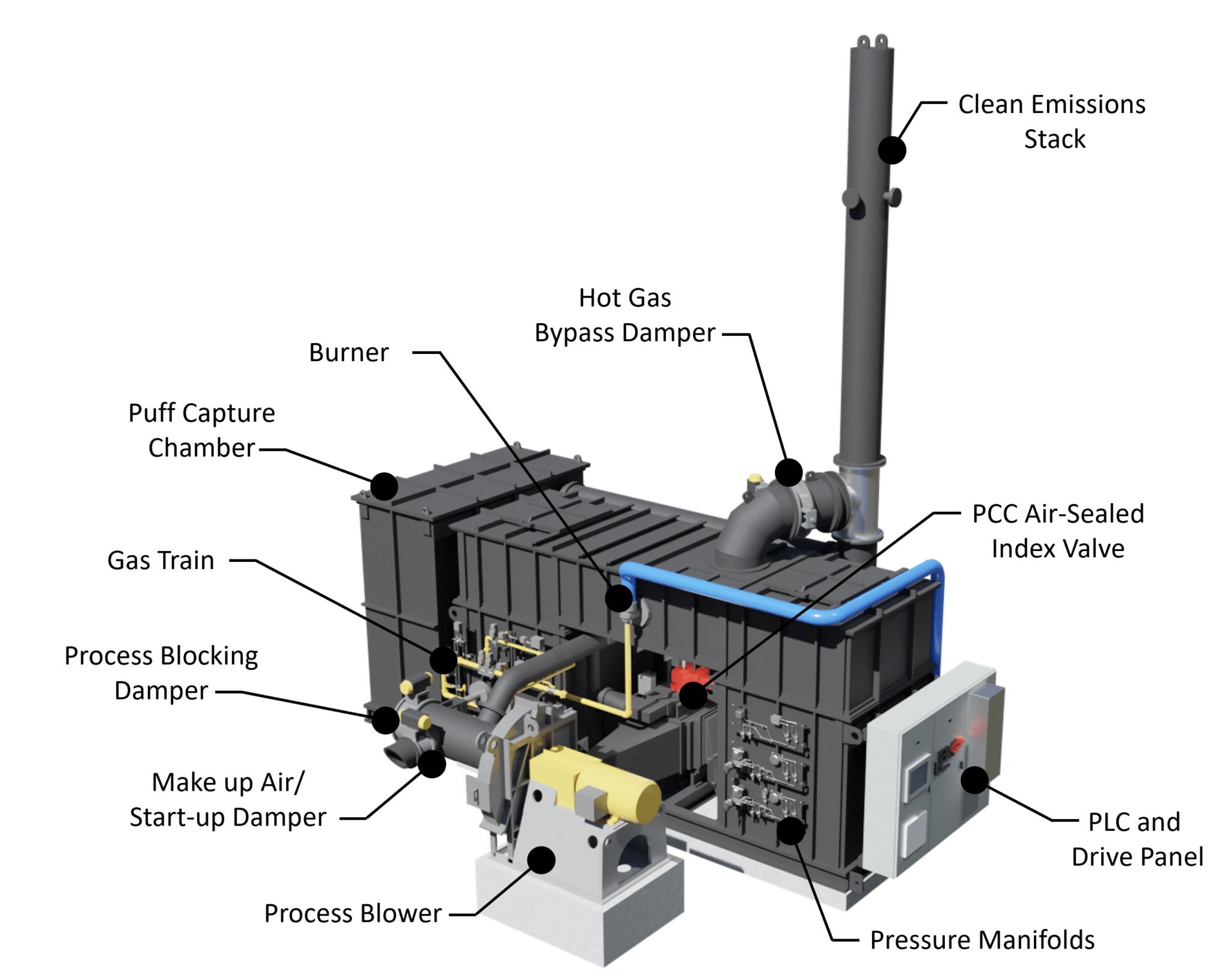
An RTO is not simply a box with a burner. Each component has a direct role in destruction efficiency, heat recovery, uptime, safety, or serviceability.
- Ceramic media beds: Store and release heat. Media selection and bed design affect pressure drop, heat transfer, and fouling tolerance.
- Combustion chamber: Provides residence time needed for oxidation.
- Burner system: Brings the unit to temperature and supplements heat when VOC loading is not enough to sustain operation.
- Valves and actuators: Directs flow through the chambers, switching flow direction at pre-determined intervals.
- Controls: Manage sequencing, safety interlocks, temperature control, alarms, and diagnostics.
- Fans and ductwork: Maintain the required airflow and draft while accounting for system pressure drop.
When an RTO Is a Strong Fit
An RTO is often a strong candidate across a variety of industrial sectors, especially lighter industry and applications where the stream is air laden. Common applications include chemical process vents, pharmaceutical manufacturing, coating and paint exhaust (paint booths), food and beverage manufacturing, odor control, food and beverage manufacturing, odor control, metal shredding, and other industrial processes that require dependable VOC or HAP destruction.
The best-fit applications usually have enough process consistency for stable operation and a contaminant profile that will not rapidly blind, plug, corrode, or coat the media. Even when the stream has meaningful variability, an RTO may still be the right answer. The system must be designed for that variability rather than sized around a single normal operating point.
For early-stage planning, PCC's RTO design and cost calculator can help teams evaluate waste-gas temperature, flow, oxygen content, utility costs, and heat release before a detailed engineering review.
When an RTO May Be the Wrong Answer
A common misconception is that high heat recovery automatically makes an RTO the best oxidizer. Heat recovery is valuable only when the system can remain clean, controllable, safe, and compliant.
Streams with heavy particulate, sticky condensables, paint residue, or tar-like compounds can foul ceramic media and increase pressure drop. Streams containing halogenated VOCs can form corrosive acid gases during oxidation and may require corrosion-resistant materials, quenching, downstream scrubbing, or a different treatment train. Highly variable or rich process streams with significant organic content can cause the RTO to overheat.
For some applications, an engineered scrubber system, direct-fired thermal oxidizer, recuperative oxidizer, flameless thermal oxidizer, or integrated thermal-oxidizer-and-scrubber package may be a better fit. The right answer depends on the waste-stream characteristics and operating conditions.

RTO Selection Criteria That Actually Matter
As we’ve shown, choosing an RTO starts with the process stream. Typical parameters that need to be considered are the exhaust flow range, inlet temperature, VOC species, concentration range, moisture, particulate, oxygen level, operating schedule, and required permitted limits.
From there, the design hinges on several engineering decisions: required residence time, burner capacity, ceramic media volume, valve design, purge strategy, materials of construction, control philosophy, and access for maintenance. If the stream has significant organic content, LEL monitoring and dilution or bypass strategy may need to be addressed early in the selection process. For these reasons, PCC customizes each RTO solution around the specific parameters provided.
RTO Cost and Cost of Ownership
RTO cost varies with airflow, contaminant loading, materials, chamber configuration, controls, installation scope, and site integration. In general, there is a baseline cost associated with all RTO sizes to supply instrumentation, controls, and engineering. For this reason, an RTO that treats double the flow will not cost double the price.
Capital cost is only one part of the decision. Fuel use, pressure drop, fan horsepower, media cleaning or replacement, valve maintenance, burner tuning, controls support, and downtime risk all shape total cost of ownership.
Reliability and Maintenance Questions to Ask Early
Reliability should be evaluated before the purchase is made. Consider asking the following questions:
- How many switching cycles are the valves and actuators rated for, and what are the typical lead times for replacement parts?
- How is media condition monitored, and what triggers a cleaning or replacement decision?
- What physical access does the media-bed design provide for cleanout or replacement without a full system teardown?
- How do the controls identify abnormal switching, temperature imbalance, or pressure-drop changes before they become a compliance or downtime issue?
The design should also address what happens when the stream is not ideal. Coating exhaust, sticky organics, particulate carryover, and condensables can change the maintenance profile. A well-engineered RTO accounts for these risks through upstream conditioning, appropriate media selection, cleanout access, control logic, or a different technology recommendation when needed.
If the project is still being evaluated, an engineering study can help define the design basis before the plant commits to a specific oxidizer configuration.
How to Evaluate Regenerative Thermal Oxidizer Manufacturers
Regenerative thermal oxidizer manufacturers should be evaluated on more than equipment dimensions and price. The more important question is whether the manufacturer understands the application well enough to defend the design after years of operation.
Look for application-specific questions during the discovery process. A credible manufacturer should ask about operating modes, upset conditions, solvent variability, maintenance access, required destruction and removal efficiency, controls integration, and permitting constraints. The manufacturer should also be willing to explain when an RTO is not the correct technology.
PCC has engineered process combustion and air pollution control systems since 1969, including thermal oxidizers, scrubbers, combustion systems, and waste heat recovery equipment. Our broader portfolio matters because the recommendation can be built around the stream instead of around a single product category.
What to Bring to an RTO Sizing Consultation
If you are evaluating an RTO, the next step is a sizing consultation based on your exhaust profile, permit limits, operating schedule, and site constraints.
Bring the following information to the consultation:
- Exhaust flow range
- Inlet temperature
- VOC composition
- Expected concentration swings
- Particulate or condensable concerns
- % LEL information
- Oxygen content
- Corrosive constituents
- Utility constraints
- Operating schedule and upset conditions
- Applicable permit limits
- Known maintenance issues with existing equipment
PCC can use this information to determine whether an RTO is the right fit, which configuration makes sense, and whether another emissions-control approach may be safer or more economical.
Request an RTO sizing consultation to review your application with a PCC combustion engineer.
Frequently Asked Questions
Ready to Discuss Your Application?
Contact PCC's engineering team to learn how our solutions can address your emission control requirements.